
How to Choose the Right Air Duct Cleaning Company in Tacoma
Washington State doesn’t require a specific license to clean air ducts, which means the credential that actually matters is what’s on the truck, not what’s on the business card. That’s an uncomfortable fact in a trade where homeowners are asked to trust a stranger with a system they can’t see inside. The good news: you don’t need a wall of certifications to vet a contractor. You need to ask a few direct questions about equipment and scope, and you need the answers in writing before anyone starts work. If you’d rather skip the research and talk to a pro, call (877) 792-6386.
Why Licensing Isn’t the Filter in Tacoma (and What Is)
Most home service trades in Tacoma are gated by a state license: electricians, plumbers, and HVAC contractors all operate under specific credentialing. Air duct cleaning sits in a gray zone. A general business registration and a contractor registration are the typical minimums, but neither one tells you whether the crew that shows up knows a supply plenum from a return drop.
So the filter has to be something else. In our experience, it comes down to two things you can actually verify before booking:
- Equipment class. A professional truck-mounted or high-powered portable system with proper negative pressure and contact tooling is a fundamentally different machine from a shop vac with a hose extension.
- Process. What gets cleaned, how it gets cleaned, how the debris is contained, and how the work is documented in photos.
A business card full of logos proves someone paid for memberships. A straight answer about CFM and negative pressure proves someone runs a real operation. Tacoma homeowners with older homes and heat pump systems should weight the second category heavily, because the duct layout in a mid-century Tacoma house often includes awkward runs and tight attic spaces that expose the difference between equipment classes fast.
If you want to see what a full-scope job looks like before you start calling, our air duct cleaning page walks through the process step by step.
What NADCA Membership Actually Verifies
NADCA (the National Air Duct Cleaners Association) is the trade body most often cited in this industry, and membership is worth understanding precisely, because it’s frequently oversold. Membership verifies that a company has agreed to a code of ethics and, in most cases, that at least one person on staff has completed the association’s certification course. That’s a real commitment and a reasonable floor to look for.
What it doesn’t verify is the equipment on the truck, the crew’s hands-on experience, or the quality of a specific job. A company can hold membership and still send a two-person crew with undersized gear. It’s a floor, not a ceiling.
Think of NADCA membership the same way you’d think of a college degree on a resume. It tells you the person showed up and passed. It doesn’t tell you how they’ll handle your specific system. Use it as one check among several, not as a substitute for asking about CFM ratings and containment methods. A Tacoma contractor who holds membership and can also explain their negative pressure setup in plain English is a much stronger signal than a membership badge alone.
The Equipment Questions to Ask Any Tacoma Contractor
This is the part most homeowners skip, and it’s the part that actually determines whether your service call produces a cleaner system or an invoice. Ask these questions directly and pay attention to whether the answers are specific:
- What’s the CFM rating on your system? CFM (cubic feet per minute) measures air movement. A real duct cleaning rig runs in the thousands of CFM. If the answer is vague or a number under a thousand, the equipment is probably a portable unit that won’t generate enough velocity to pull heavy debris out of long runs.
- Do you use negative pressure, and how is it set up? Negative pressure means the system is sealed and a vacuum is pulling air (and debris) toward a collection point, so loosened material doesn’t drift into your living space. Ask where the vacuum hooks up and how they seal the registers.
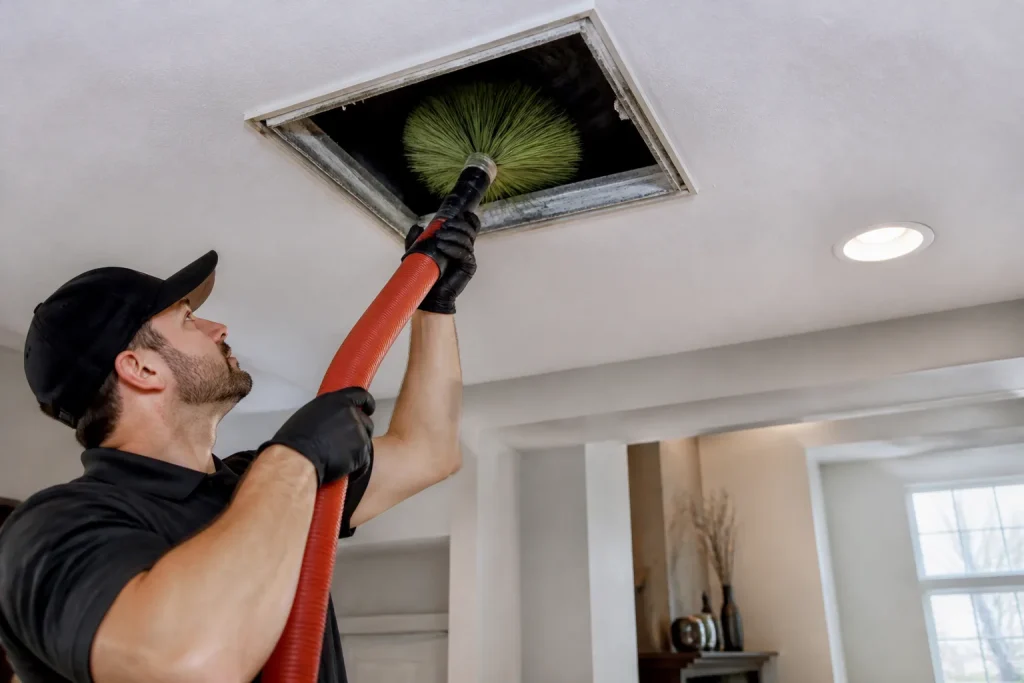
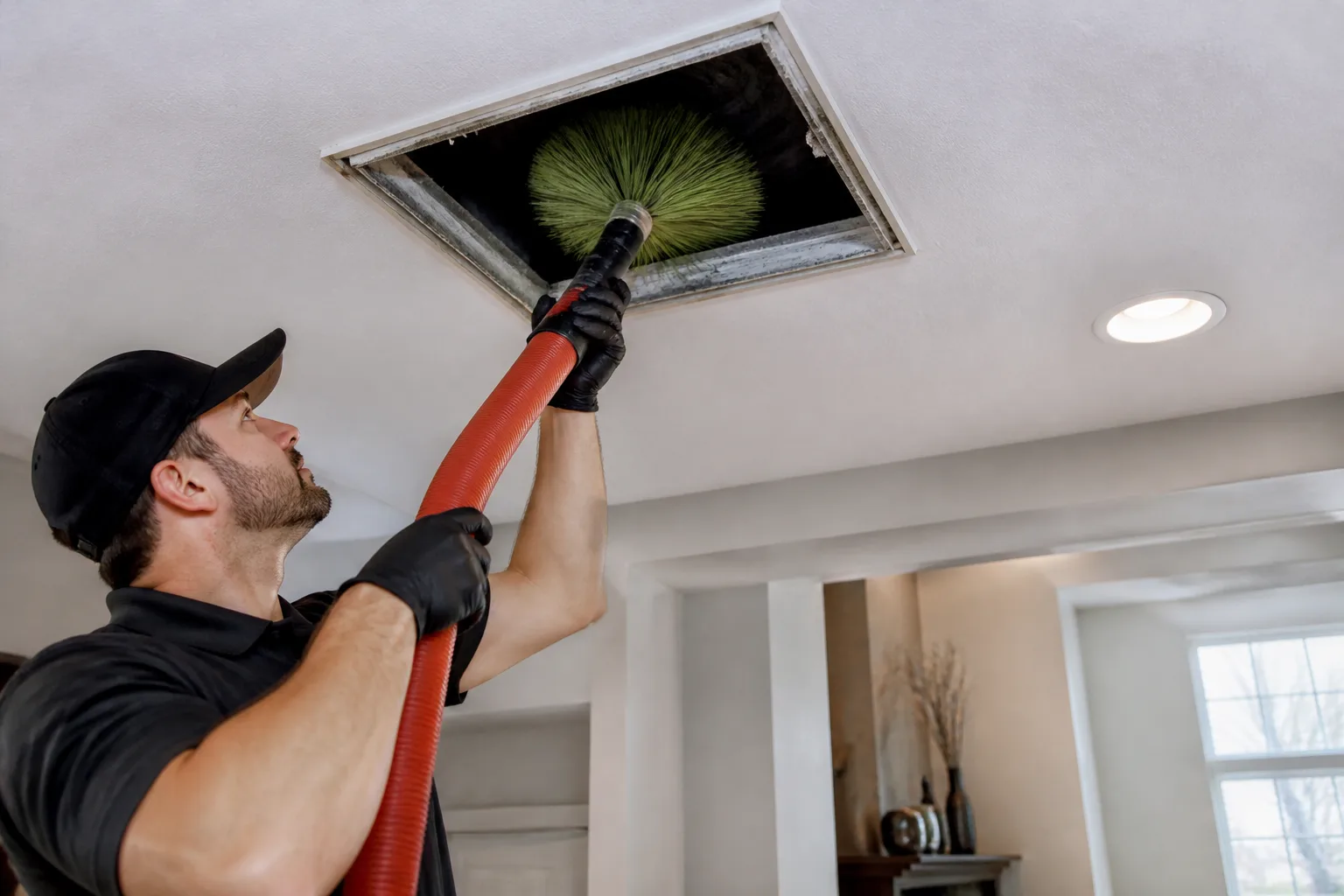
- What contact cleaning tools do you use? Air alone won’t dislodge caked-on buildup. Look for rotary brush systems, whip lines, and compressed-air tools that physically contact the duct walls.
- What equipment brand do you run? This matters because professional-grade platforms are built for the job. Rotobrush and Nikro systems are industry standards in residential duct and HVAC cleaning. Abatement Technologies equipment is used in commercial remediation and signals a contamination-control mindset. A company running rental or consumer-grade gear will usually dodge this question.
- How do you document the work? Before-and-after photos of your own ducts should be standard. If they aren’t offered, ask.
The answers to these five questions will separate a professional operation from a crew with a vacuum and a schedule to fill. They’ll also tell you quickly whether the person on the phone has ever been on a job site.
Get the Scope of Work in Writing Before Anyone Starts
Verbal promises evaporate the moment a technician is in your driveway. The written scope of work is your protection, and a legitimate company will provide one without being pushed. It should spell out, at a minimum:
- Every register and return that will be cleaned, listed by location (not “all vents” as a vague promise).
- The air handler unit and whether the blower compartment is included.
- Return plenums and the supply plenum, which are the large ducts immediately around the air handler and often where the worst buildup lives.
- The main trunk lines and branch runs included in the price.
- Whether sanitizing or sealing is part of the service or an add-on and, if it’s an add-on, what it costs and what product is used.
Ask specifically whether the scope covers the coil. A duct cleaning that stops at the registers but leaves a fouled evaporator coil untouched is a partial job, and the coil is often where the biological growth and dust mat actually live. In Tacoma homes with heat pumps, the indoor coil is a recurring hotspot and deserves explicit mention in the scope.
If a company won’t put the register count, the air handler, and the plenums in writing before starting, that’s your answer about how the rest of the job will go.
Why a One-Service Operation Is Structurally Limited
A company that only cleans ducts can only sell you duct cleaning. That’s not a knock on their skills; it’s a structural reality of how a single-service business works. When the only tool in the toolbox is a duct cleaning rig, every problem looks like a duct cleaning problem, including problems that aren’t.
Duct cleaning is one of five related jobs on a real air system, and the others overlap constantly:
- Dryer vent cleaning addresses a separate but related fire-risk pathway. If a contractor offers duct work but not dryer vent service, they’re leaving a major venting system in your home unexamined.
- HVAC cleaning includes the coil, blower, and cabinet, which is where duct cleaning stops.
- Duct repair and sealing deals with disconnected joints, crushed flex runs, and leaky seams, which are the actual cause of poor airflow and dust intrusion in a lot of older Tacoma systems. Cleaning around a broken duct joint just re-contaminates the system.
- Air quality and sanitizing handles the contamination left behind after cleaning and addresses larger air-quality concerns with products from brands like Honeywell and Aprilaire.
In our experience, a full-scope specialist can diagnose all of these in one visit. A one-service operation can only diagnose the one problem they’re set up to solve. Our HVAC cleaning page explains what that coil and blower service actually involves.
Red Flags Specific to the Tacoma Market
The duct cleaning industry has earned some of its bad reputation honestly, and a handful of sales behaviors show up repeatedly in this region. Learn to spot them and you’ll avoid most of the bad outcomes:
- Mold scare tactics. A technician who pulls a phone photo of “mold” and offers to test it on the spot, or who tells you your home is unsafe to breathe in until you sign a remediation contract, is selling fear, not service. Legitimate contamination concerns get documented and discussed, not weaponized.
- Per-vent pricing traps. A low advertised price that turns into a per-register charge once the crew arrives is a classic. A real job is priced per system, with the scope written down first.
- Mid-job add-on pressure. You’re quoted one number, the technician arrives, and suddenly you need an “emergency sanitizing treatment” or a “sealant” or the work won’t be done right. The time to discuss add-ons is before the work starts, not halfway through.
- Pressure to sign today. Legitimate estimates don’t expire in an hour.
- No photos, no proof. If nobody can show you the before and after, you have no way to confirm the work happened.
None of these are unique to duct cleaning, but they concentrate here because the barrier to entry is low. That’s the tax the industry pays for light regulation, and it’s why asking about equipment and getting the scope in writing is worth the extra ten minutes.
When to call a pro
If you’re noticing new dust settling on surfaces within days of cleaning, visible debris around return registers, uneven airflow between rooms, or a musty smell when the system kicks on, those are all signals worth a professional assessment rather than another round of cleaning. Duct cleaning alone won’t fix a system with a disconnected joint or a crushed run. Our dryer vent cleaning service is worth a look too if you haven’t had yours examined recently.
The Bottom Line
The right company in Tacoma isn’t the one with the most logos on its website. It’s the one that can tell you the CFM rating on its rig, explain its negative pressure setup, put every register and the air handler in the written scope, and show you photos when the job is done. NADCA membership is a reasonable floor, but it’s the equipment class and the process that actually determine the result. And a full-scope specialist, one that handles cleaning, HVAC service, duct repair, and air quality together, can catch problems a single-service crew will simply clean around.
Our technicians have up to 11 years of experience, and we run professional-grade platforms from Rotobrush, Nikro, and Abatement Technologies, with air-quality products from Honeywell and Aprilaire available when a job calls for them. If you’re in Tacoma and want an honest read on your system, Air Duct Cleaning Tacoma Pros offers free estimates. Call (877) 792-6386. We answer 24/7. Fast dispatch from 7am to 7pm, Sunday through Friday.
Frequently Asked Questions
Ask about equipment and scope before booking, and ask for both in writing. A legitimate company can tell you the CFM rating on its system, describe its negative pressure setup, name the equipment brands it runs, and provide a written scope that lists every register, the air handler, and the return plenums. NADCA membership is a useful floor, but it doesn’t verify equipment quality or crew experience on a specific job. Call (877) 792-6386 for a free estimate.
No. NADCA membership verifies adherence to a code of ethics and, in most cases, that at least one employee has completed the association’s certification course. It doesn’t verify the equipment on the truck, the crew’s experience, or the quality of a specific job. Treat it as one useful check, not the whole vetting process. Call (877) 792-6386 with questions about what a job in your Tacoma home would involve.
Usually because they’re quoting a different job. Low quotes often exclude the air handler, the return plenums, or the main trunk lines, or they use portable consumer-grade equipment that can’t generate enough airflow to move heavy debris. Sometimes it’s per-vent pricing that balloons once the crew arrives. A whole-system quote with the scope written out is the only comparison worth making. Call (877) 792-6386 for a free estimate.
Yes. The evaporator coil, blower, and dryer vent are all part of the same air system, and problems in any of them affect what’s happening in your ducts. A company that only cleans ducts is structurally limited in what it can diagnose and what it can fix. Full-scope providers can address cleaning, HVAC service, duct repair and sealing, dryer vent service, and air sanitizing in one assessment. Call (877) 792-6386 to talk through what your Tacoma system needs.
Written by the team at Air Duct Cleaning Tacoma Pros.
Need Air Duct Cleaning Help?
Call Air Duct Cleaning Tacoma Pros - the local pro we connect you with is licensed and insured, here with fast help in Tacoma.
(877) 792-6386