
Abatement Technologies Air Duct Cleaning in Tacoma: A Homeowner’s Guide
If a contractor is quoting Abatement Technologies equipment for your home, it’s worth understanding why. This gear was designed for hospital construction sites and mold remediation, not routine dust removal. Abatement Technologies air duct cleaning in Tacoma means the crew is treating your ducts as a contamination problem to be contained, not just a pile of dust to be vacuumed. That distinction matters most in the specific situations we cover below. And if you’d rather have a pro assess it than guess from a search results page, call (877) 792-6386.
What Makes Abatement Technologies Equipment Different From a Standard Duct Vacuum?
Standard duct cleaning equipment removes loose debris from the inside of your ductwork. Abatement Technologies equipment is built to contain hazardous particulate – mold spores, construction dust, biological contamination – and keep it from spreading through your home while the work is happening.
The difference comes down to filtration class and air pressure control:
- HEPA filtration: Abatement units filter exhaust air at HEPA efficiency, capturing particles at the sub-micron level that a standard vacuum’s filter bag lets pass straight back into the room.
- Negative air machines: These units pull the work area into negative pressure, so air flows into the containment zone rather than out of it. Contaminants get pulled toward the machine instead of pushed into your living room.
- Sealed containment: The equipment pairs with plastic sheeting and zipper doors to isolate the work zone, which is standard practice in remediation but rare in residential duct cleaning.
- Continuous duty rating: Remediation-grade machines run for hours without losing suction, which matters on a job that takes a full day rather than an afternoon.
A standard Rotobrush or Nikro setup handles routine maintenance cleaning well. Abatement-class equipment enters the picture when the contamination load is high enough that containment becomes the priority, not just removal.
When Does a Tacoma Home Actually Need Remediation-Grade Duct Cleaning?
Most Tacoma homes need routine cleaning. A smaller number need the remediation-grade approach, and those homes usually fall into one of four scenarios.
- Post-flood or water damage: Water intrusion into a crawl space or wall cavity can wet insulation and duct runs. Once ductwork has been wet, the interior lining becomes a growth surface for mold, and standard vacuuming risks aerosolizing spores through the house.
- Active mold remediation: If a mold assessment has already flagged contamination in the HVAC system or the ducts connected to it, cleaning without containment can make the problem worse before it gets better.
- Post-construction cleanup: Renovations push drywall dust, sawdust, and silica particulate into return ducts. Fine construction dust is exactly the particle size that standard filters miss and that HEPA equipment is designed to capture.
- Rodent or pest contamination: Droppings and nesting material in ductwork carry pathogens and require containment, not just a vacuum pass.
Outside those four, routine air duct cleaning is usually the right scope. The point isn’t to upsell remediation equipment onto every Tacoma job; it’s to match the equipment class to the actual contamination.
How Does Negative Air Pressure Containment Work in a House?
Negative air pressure means the air pressure inside the work zone is lower than the pressure in the rest of the house. Because air moves from higher pressure to lower pressure, air flows into the contained area – carrying contaminants with it – rather than out into your living space.
In a residential duct job, here’s how that plays out in practice:
- The work area gets sealed off with plastic sheeting and a zipper door.
- A HEPA negative air machine sits inside the containment, exhausting filtered air while pulling the zone into negative pressure.
- The duct system itself gets connected to a HEPA vacuum, so debris pulled from the ducts goes into a sealed collection rather than into the room.
- The pressure differential is monitored during the job. If containment fails, work stops until it’s restored.
Why this matters for mold spores specifically: a mold spore is small enough to stay airborne for a long time and small enough to pass through a standard filter bag. Without containment, cleaning a contaminated duct system can redistribute spores through the whole house. With it, the spores go into the machine instead of your hallway. This is the same logic commercial contractors use in hospitals and schools during renovations – the enclosed space keeps the contaminant in, and the filtration keeps the exhausted air clean.
What Does a Remediation-Grade Duct Job in Tacoma Actually Involve?
A job scoped for Abatement-class equipment takes longer and involves more prep than routine cleaning. Here’s what to expect, in general terms.
Prep. Furniture and flooring in the work path get protected. The work zone gets sealed into containment. Return and supply registers are removed and cleaned separately. The HVAC system is isolated so the air handler can’t pull contamination back into the loop while work is underway.
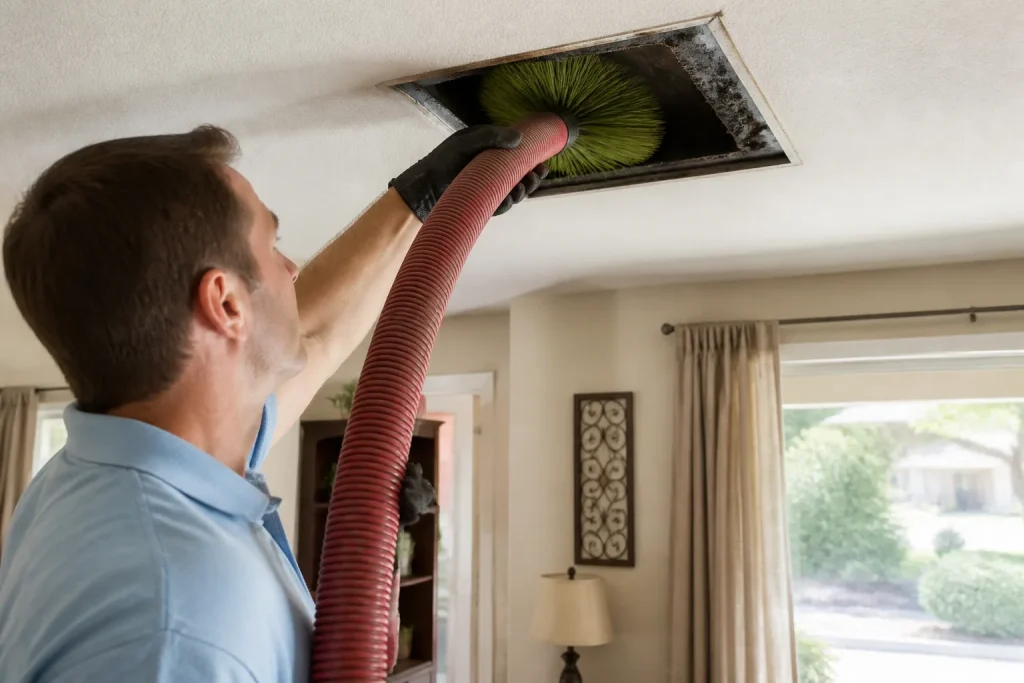
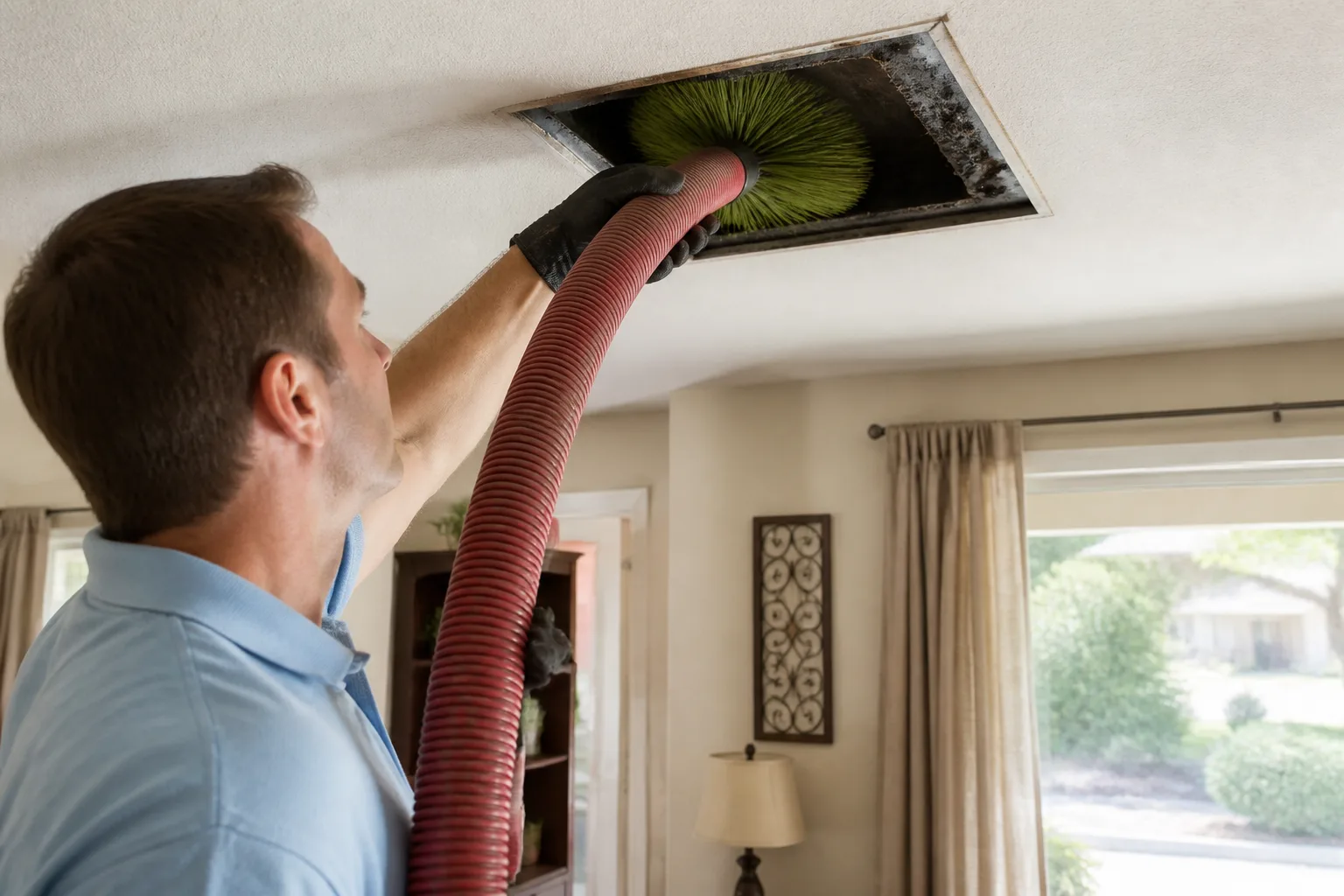
Cleaning. Duct runs get mechanically agitated to loosen debris from the walls, then pulled into HEPA vacuum collection. If the ducts include a wet or damaged section, it gets flagged and addressed on the spot; this is where air duct cleaning pairs naturally with duct repair and sealing, because cleaning around a failed joint doesn’t solve the underlying problem.
Post-job air quality check. A properly scoped remediation-grade job includes a verification step. That might mean a visual inspection of the duct interior, a particle count comparison, or both. You should get documentation of the before-and-after condition, and with the caliber of equipment on site, you should also get before-and-after photos of your own ducts.
Timeline. A routine Tacoma duct cleaning typically runs a few hours. A remediation-grade job with containment setup, full duct cleaning, and verification is usually a full-day scope. If the job also touches the HVAC cabinet and coil, plan for longer – HVAC cleaning is a separate scope that adds time.
Why Tacoma’s Climate and Housing Stock Push More Homes Into This Category
Tacoma’s wet climate is the single biggest driver behind the demand for remediation-grade duct work here. The region gets a lot of rain and limited drying hours through much of the year, and that combination is hard on building materials that get wet and stay wet.
Older Tacoma housing stock amplifies the problem. A lot of the city’s homes were built with ductwork and crawl space construction that wasn’t designed with modern moisture control in mind. Combined with Tacoma’s wet season, that means:
- Crawl spaces and duct runs stay damp longer, and damp duct walls are a growth surface for mold.
- Older duct insulation loses integrity over time, and failing insulation lets condensation collect where you can’t see it.
- Return ducts pick up more ambient moisture from a wet crawl space than they would in a drier climate.
- Aging duct systems develop the leaks and gaps that let outdoor humidity and crawl space air back into the system.
None of this means every Tacoma home needs remediation-grade cleaning. It means the number of Tacoma homes where routine cleaning isn’t enough is higher than in a drier city, which is why Abatement-class equipment shows up in residential quotes here more often than you might expect. This is also the climate argument for air duct cleaning being scheduled on a regular cadence rather than waiting for a visible problem – catching moisture issues early keeps you in the routine-cleaning category instead of the remediation one.
When to Call a Pro (and Related Tacoma Services)
If you’re seeing musty odors when the heat or AC kicks on, noticing dust settling on surfaces right after a cleaning pass, or dealing with a recent water event or renovation, those are the signals to get the duct system looked at. A trained technician can tell the difference between routine dust and contamination that needs containment, and Our technicians have up to 11 years of experience assessing exactly that distinction.
Related services in Tacoma that often come up during the same assessment:
- dryer vent cleaning – the lint problem is a separate risk from the dust problem, and worth combining with an air duct visit
- HVAC cleaning – the coil and cabinet pick up the same contamination the ducts do
- Duct repair and sealing – fixing the leaks that let moisture back into a cleaned system
- Air sanitizing – post-cleaning treatment to complete the job
What happens when you call
- 1
A real person answersNo phone trees – you reach a local pro.
- 2
You get an upfront price rangeHonest numbers before anyone is dispatched.
- 3
A background-checked tech heads outLicensed & insured, dispatched right away.
- 4
You approve before work beginsNothing starts until you say go.
The Bottom Line
Abatement Technologies equipment shows up in Tacoma duct quotes for a specific reason: containment, HEPA filtration, and negative air pressure are the right tools when the problem is contamination rather than dust. For most Tacoma homes, routine cleaning with a Rotobrush or Nikro system is the correct scope, and it’s honest to say so. For post-flood, post-construction, mold-affected, or pest-contaminated ductwork, remediation-grade gear is the difference between containing the problem and spreading it.
The tradeoffs, in short:
- Match the tool to the problem. Routine dust gets routine equipment. Contamination gets containment.
- Ask what gets tested and photographed. A remediation-grade job includes verification; ask how yours will be documented.
- Ask what’s being repaired, not just cleaned. If your Tacoma home has failing duct joints or insulation, cleaning alone won’t fix the root cause.
- Get the price set before work starts. You should know the scope, the flat price for the job, and what’s included before anything gets connected to your system.
If you’re in Tacoma and need help, Air Duct Cleaning Tacoma Pros offers free estimates – call (877) 792-6386. We answer 24/7. Fast dispatch from 7am to 7pm, Sunday through Friday. The written estimate sets the final price, and the local pro is licensed and insured as their state requires.
Frequently Asked Questions
Not for routine cleaning, no. A standard Rotobrush or Nikro system handles normal dust and debris well. Abatement-class equipment becomes appropriate when contamination is present – mold, post-flood moisture, construction particulate, or pest material – because it’s built to contain those contaminants rather than just remove debris. If a Tacoma contractor is quoting this equipment, ask what contamination assessment justifies the scope. Call (877) 792-6386 for a free estimate and we’ll walk you through the reasoning.
Remediation-grade duct cleaning costs more than routine cleaning because of the containment setup, full-day scope, filtration class, and verification step. Exact cost depends on system size, number of runs, and contamination level. The honest answer is that a remediation job is priced per job by estimate, not per vent, and you should get the flat price set before work begins. Call (877) 792-6386 for a free estimate.
Look for the four markers: a recent water event, an active mold assessment, a recent renovation, or pest evidence in the ducts. If none apply and you’re just overdue for maintenance, routine cleaning is the right scope. If any of the four apply, bring them up with the technician reading the quote. When in doubt, the assessment comes before the quote – call (877) 792-6386.
A properly scoped job should include verification, and you should ask what that looks like in writing. That could be a particle count comparison, a visual inspection, before-and-after photos, or a combination. If a Tacoma contractor can’t tell you how the job gets verified, ask why. Call (877) 792-6386 for a free estimate.
They should be, and it’s fair to ask. Equipment class tells you what the job is designed to handle – a HEPA-rated remediation setup is different from a standard vacuum, and the estimate should reflect that. We use professional-grade equipment brands including Rotobrush, Nikro, and Abatement Technologies, and we’ll tell you which is appropriate for your Tacoma home and why. Call (877) 792-6386.
Written by the team at Air Duct Cleaning Tacoma Pros.
Need Air Duct Cleaning Help?
Call Air Duct Cleaning Tacoma Pros - the local pro we connect you with is licensed and insured, here with fast help in Tacoma.
(877) 792-6386